Cruise directors are some of the most visible people on a ship. They host events, introduce shows, make announcements, and help keep the daily program moving for passengers across the ship.
But behind the microphone, cruise ship work can be complicated.
Many crew members work on fixed-term contracts, rotating on and off ships for months at a time. That setup is common at sea, but an Italian labor court has now ruled that one former Costa Cruises cruise director’s long-running contract arrangement went too far.
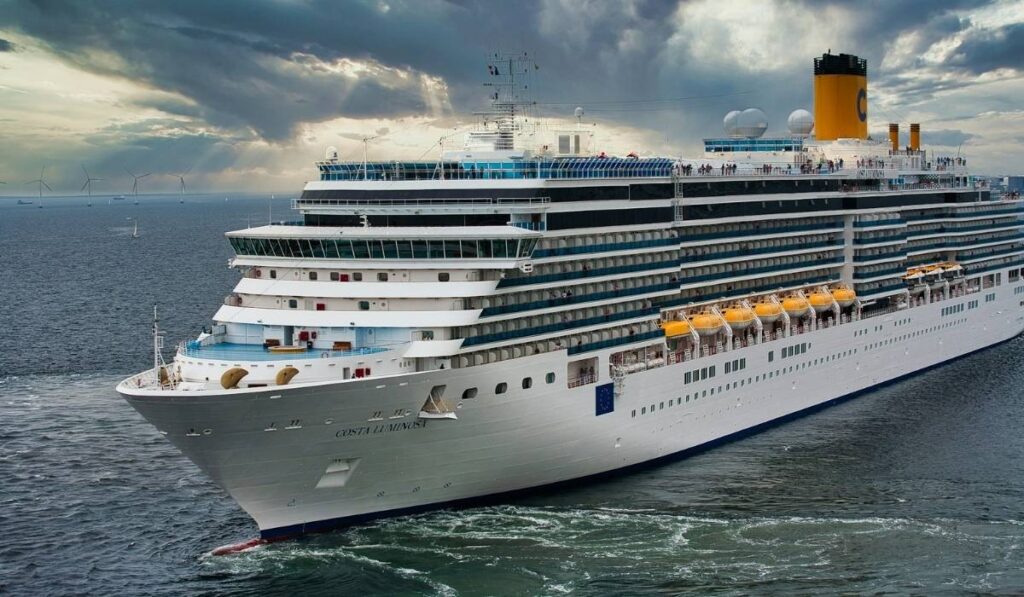
Costa Cruise Director Wins Court Case After Years of Contracts
A former Costa Cruises cruise director has been awarded more than €130,000 after an Italian labor court found that repeated temporary contracts had been used for too long.
The case was heard by the Bari Labor Court in Italy. The worker is from Taranto and worked aboard Costa Cruises ships for 18 years before his most recent contract was not renewed.
The ruling did not simply focus on the fact that he had worked at sea under fixed-term contracts. That’s common in cruising.
The issue was the length and pattern of those contracts over nearly two decades. The court found that the worker’s role had, in practice, become a long-term working relationship rather than a temporary one.
The Worker Had 51 Contracts Over 18 Years
The cruise director reportedly worked from 2003 to 2021 under 51 separate contracts.
Those contracts were linked to Cruise Ships Catering and Services International NV, a Curaçao-based company connected to Costa Cruises operations. That detail matters because cruise employment can involve agencies, manning companies, and third-party businesses in different countries.
For passengers, the person on stage is simply the cruise director. Behind the scenes, the paperwork can be much less simple.
According to the reporting, the worker’s final contract was not renewed after years of repeated employment. He then challenged the arrangement in court.
Italian media reported that Judge Agnese Angiuli partially accepted the worker’s appeal, which was supported by lawyers Fabrizio Del Vecchio and Antonello Schinaia.
Why The Court Ruled Against The Contract Arrangement
Fixed-term contracts are normal in the cruise industry. Crew members often work a set number of months at sea, take leave, and then return for another contract.
That system makes sense for ships, which operate all year and need crew to rotate in and out. A cruise ship can’t simply close the office for the weekend and let everyone catch up on emails Monday morning.
But the Bari court appears to have drawn a line between normal crew rotation and using temporary contracts for work that had effectively become continuous.
According to reports, the court found that the arrangement breached Italian and European labor rules because the company had relied on the worker’s services over a long period while still treating the role as temporary.
In practical terms, after 51 contracts and 18 years, the court viewed the working relationship as something closer to permanent employment.
What The Court Ordered
The Bari Labor Court ordered that the worker be reinstated and hired on an indefinite contract.
It also awarded compensation of more than €130,000, plus interest and monetary revaluation, according to Italian reporting.
The financial award was reportedly based on the worker’s final salary and years of service.
The court did not grant everything the worker sought. Claims relating to non-financial damages were rejected, meaning the award focused on financial loss rather than emotional or moral damages.
At the time of reporting, Costa Cruises had not issued a widely reported public statement on the decision.
Related reading: What Cruise Ship Crew REALLY Get Paid
Why This Case Is Unusual In Cruising
This case is likely to attract attention from cruise crew, but it shouldn’t be read as a simple template for every worker at sea.
Costa Cruises has a particularly strong connection to Italy. The company says it has nine ships in service, all flying the Italian flag, and its headquarters are in Genoa.
That matters because a ship’s flag state, the country where the vessel is registered, plays a major role in the rules that apply onboard, including labor and operational standards. In many cases, that can be more relevant than where the crew member lives or where the cruise line’s corporate office is based, though contracts and local courts can still affect an individual case.
Many cruise ships are registered in countries such as the Bahamas, Panama, Bermuda, Malta, and Liberia. When a ship is registered in a country other than where it’s owned or operated from, it’s often described as flying a “flag of convenience.” That can affect which labor rules apply and how crew protections are enforced.
That’s why Costa’s Italian connection matters here. Because its fleet is Italian-flagged and the case was heard in Italy, the court had a stronger link to Italian and European Union labor rules than many cruise employment disputes might have.
So while this ruling is notable, it doesn’t automatically mean every long-serving cruise worker on repeated contracts would get the same result.
Could This Affect Other Cruise Crew Contracts?
The case may still raise questions for the wider cruise industry, especially where crew members work for the same operation for years under repeated fixed-term contracts.
The Maritime Labour Convention sets out broad rights for seafarers, including employment agreements, wages, work and rest hours, paid annual leave, repatriation, medical care, recruitment services, accommodation, health and safety, and complaint procedures.
But those protections don’t erase the legal differences between countries, flags, contracts, and employers.
For cruise lines, the ruling could encourage closer review of how long-term crew are contracted, especially in countries where local and EU labor laws may apply.
For crew, it may be a reminder that the wording of a contract isn’t always the only thing a court will consider.
For passengers, it’s a rare look at the working life behind the cruise director’s smile.
The case involved legal details most guests never think about while checking the daily planner or heading to the evening show. But for the people who keep cruise ships running, those details can shape years of their working lives.
Related reading: Cruise Ship Crew Expose the Dark Side of Working at Sea
Today’s Top Cruise Deals
See today’s best deals from ALL travel agents