
Royal Caribbean Ship Struck Endangered Pregnant Fin Whale in Alaska
What started as a shocking sight in Seward has become even more upsetting. Royal Caribbean’s Ovation of the Seas arrived in Alaska on June 19, 2026, with a 61-foot fin whale draped across its bulbous bow.
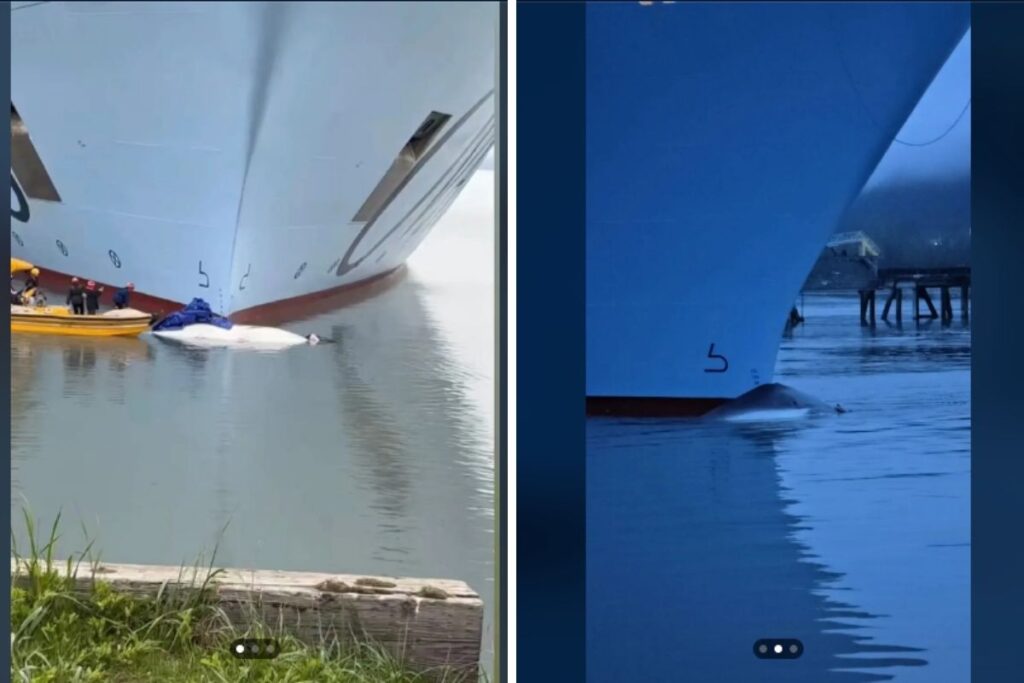
When the story first broke, it was still unclear whether the whale had been struck during the voyage or had already died before becoming lodged on the ship. Since then, federal investigators have confirmed the whale was pregnant, and preliminary necropsy findings said her injuries were “consistent with a vessel strike.”
The National Oceanic and Atmospheric Administration (NOAA) says the official cause of death is still pending further testing. So while the picture is a lot clearer now, investigators are not calling the case fully closed yet.
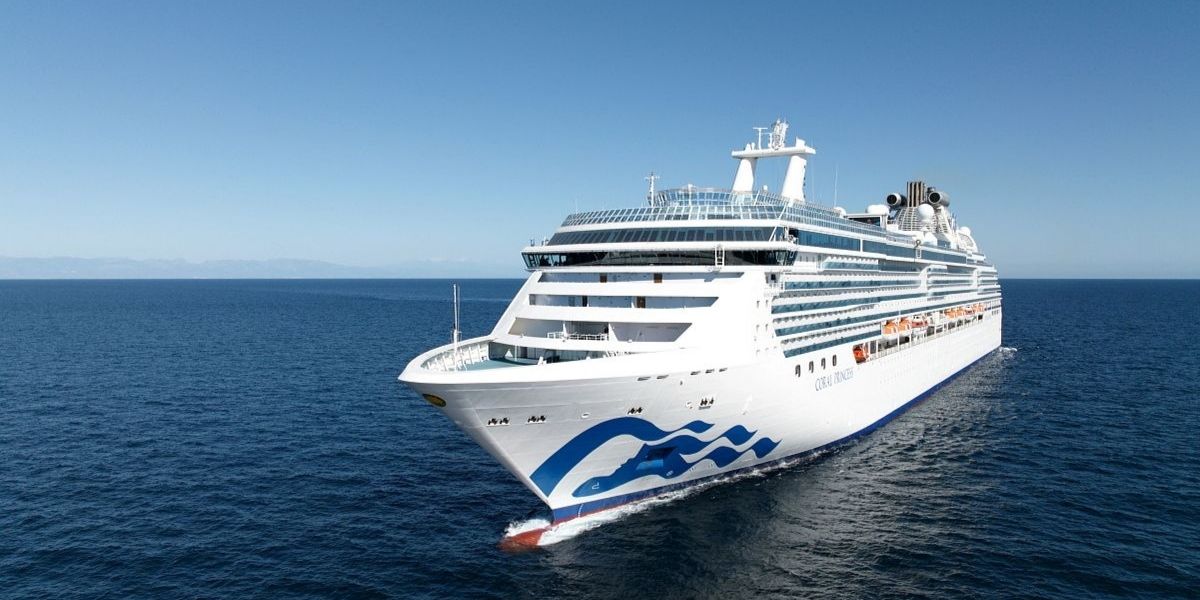
The Quantum-class ship had sailed from Vancouver on June 12 for a one-way Alaska cruise. Before reaching Seward, the itinerary included calls at Sitka, Juneau, and Skagway, along with glacier-viewing segments.
For the Alaska season, Ovation of the Seas is continuing to sail this north-south route through mid-September. The ship alternates between departures from Vancouver and Seward and carries up to 4,180 guests.
What Happened After Arrival
When the ship came into Seward, the whale was clearly visible on the rounded protrusion at the front of the hull below the waterline. That structure is known as the bulbous bow, and it helps with stability and fuel efficiency.
After docking, the carcass was covered with a tarp to shield it from public view while officials decided what to do next. Later that evening, it was moved to a sheltered lagoon near Lowell Point, around three miles south of the cruise terminal.
The necropsy was carried out by NOAA Fisheries, the Alaska SeaLife Center, and Alaska Veterinary Pathology Services. NOAA’s Office of Law Enforcement is also investigating and has asked anyone with information to come forward.
What Investigators Found
The updated findings are more troubling than the first reports suggested. NOAA said the examination revealed the whale was “pregnant, freshly dead, and in good nutritional condition,” with plenty of blubber and muscle.
Examiners also found “blunt force trauma to the jaw, spine and ribs consistent with a vessel strike.” Testing on samples taken during the necropsy could still take months, which is why the official cause of death has not been finalized.
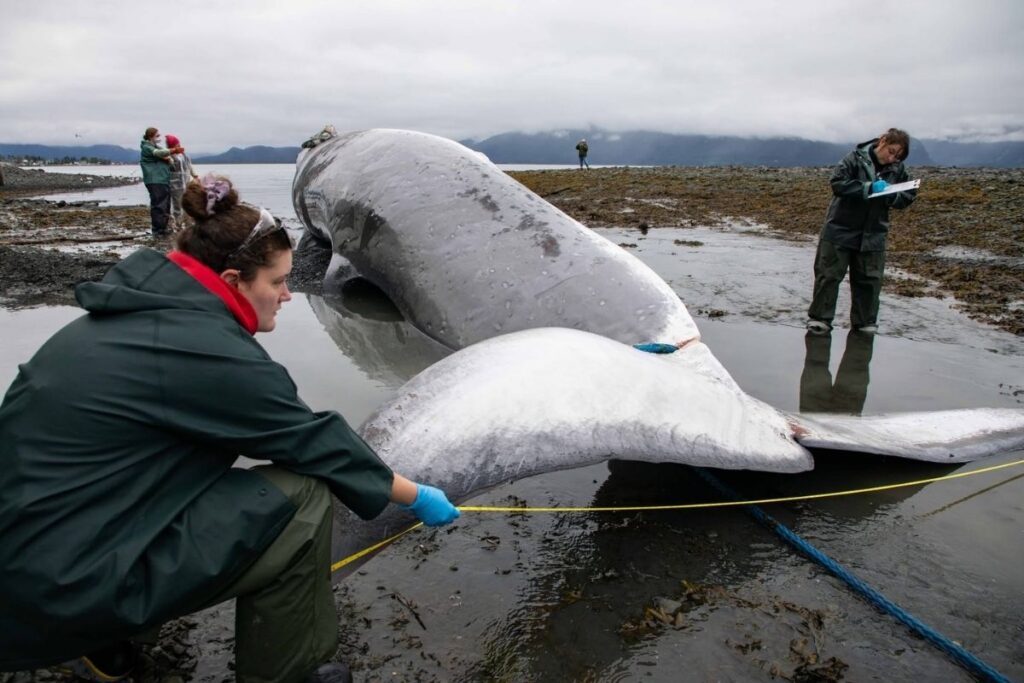
It means this is no longer just a mystery involving a whale found on a ship’s bow, but a case where early evidence points much more strongly toward a strike.
Royal Caribbean’s Response
Royal Caribbean later issued a stronger statement as more details came out. A company spokesperson said, “We are deeply saddened by the whale incident involving one of our ships en route to Seward and take any impact to marine life with the utmost seriousness.”
The company added that it is “cooperating fully with the NOAA” and will work with the agency after the final investigative findings are released. Even with all the attention around the case, the ship still departed on its next voyage as scheduled.
The timing also brought extra attention to the story. Ovation of the Seas is the first Royal Caribbean ship regularly assigned to Seward’s new Dale R. and Carol Ann Lindsey Alaska Railroad Terminal, which had only just opened earlier this month.
Why This Case Hits Harder
Fin whales are the second-largest animals on Earth, second only to blue whales. NOAA says they can grow to around 75 to 85 feet long and weigh between 40 and 80 tons.
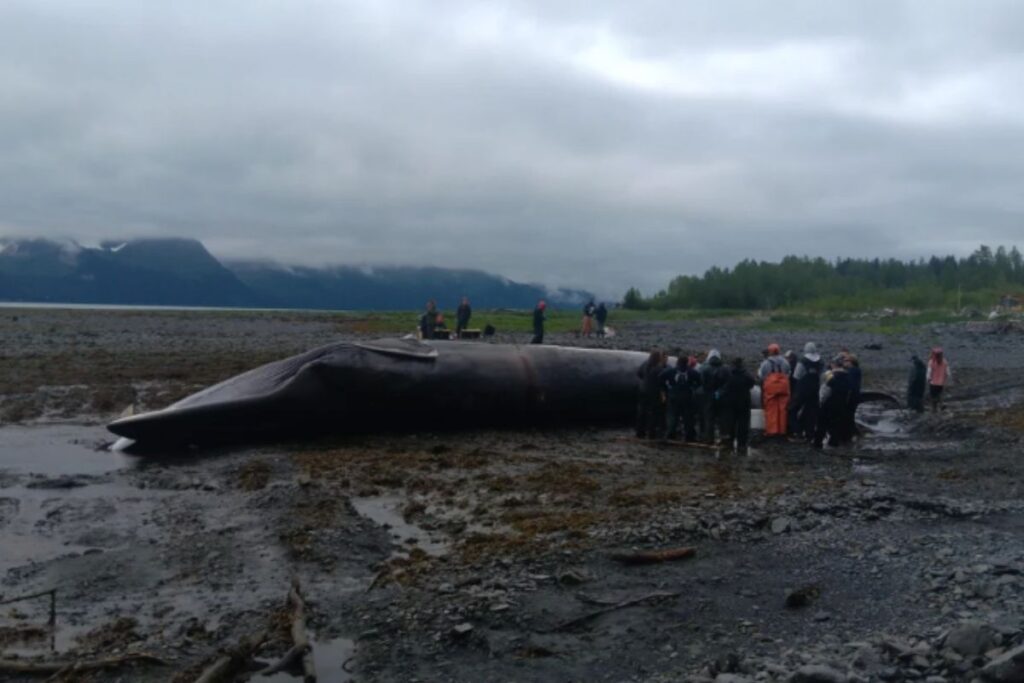
They are also listed as endangered under the Endangered Species Act and protected under the Marine Mammal Protection Act. That makes the loss of an adult female serious on its own, and the confirmed pregnancy makes it even harder to shrug off.
NOAA says vessel strikes are now one of the major threats facing fin whales. In other words, this was not just a horrible sight at the dock. It also raised bigger questions about how often large ships are crossing paths with endangered marine life.
Calls for Cruise Ships to Slow Down
The updated findings have already fueled calls for tighter speed limits in whale habitat. The Center for Biological Diversity urged Royal Caribbean to adopt a policy requiring ships to travel at 10 knots or less in important whale areas.
The group also called for more transparency about the ship’s speed and whether whales had been detected in the area before the impact. That part matters because speed is often at the center of these debates whenever a large whale is hit.
Cooper Freeman, the group’s Alaska director, said, “I’m infuriated that this supersized cruise ship hit an endangered whale in such a horrific way.” He added that “the death of this mother and baby fin whale sets back the entire population.”
Similar Cases Have Happened Before
As shocking as this was, it was not the first time a cruise ship has reached port with a whale on its bow. A similar case happened in 2016, when Holland America Line’s Zaandam arrived in Seward with a dead juvenile fin whale in nearly the same area.
In that earlier case, investigators later concluded the cruise line had not acted negligently. The ship had been traveling at recommended speeds and using posted lookouts, which shows just how difficult some of these incidents can be to prevent.
Another widely reported case happened in 2024, when MSC Cruises’ MSC Meraviglia arrived in New York with a dead whale on its bow. Together, those incidents have kept the issue of ship strikes firmly in the spotlight.
The Investigation Isn’t Over Yet
There are still some big questions hanging over this story, including exactly when the strike happened and whether speed played a role. For now, the most accurate wording is that preliminary findings were consistent with a vessel strike, while the official cause of death remains pending.
NOAA has also said plans were being made to tow the whale back out to sea, where the carcass is expected to sink and feed deep-sea marine life. It is a sobering ending to a story that has already drawn huge attention across the cruise world.
Today’s Top Cruise Deals
See today’s best deals from ALL travel agents
“REQUEST” Royal Caribbean ships to “SLOW DOWN”?! Wha? That’s it?!
Fed & state authorities should **prosecute / fine / imprison** those responsible to the fullest extent under each of the marine protection statutes! THAT and ONLY THAT — well, a **boycott, protest, other appropriate bad publicity** too — will deter this sort of CRIMINAL killings / injury / harassment of these protected creatures.
[all capitals intentional]