
If you think cruise scams are just a problem from years ago, think again.
They’re getting smarter, more polished, and in some cases, a lot more believable. I keep seeing stories from cruise passengers who thought they were booking a bargain, joining a fun group event, or grabbing an easy port deal, only to find out they’d been played.
And that’s the tricky part. Most of these scams don’t look like scams at first. They look like a discount, a helpful stranger, a friendly Facebook message, or a quick fix when you’re short on time.
The good news? Once you know what to watch for, most of them get a lot easier to spot.
1. Fake Travel Agents Offering ‘Too Good to Be True’ Deals

Cruise prices have climbed, so it’s no surprise people jump when they see a huge discount on Facebook or a little-known booking site.
That’s exactly what scammers count on.
Some set up fake travel agency pages or copy real cruise promotions to make their offers look legit. You pay a deposit, send the rest in a few installments, and only find out the booking was fake when you get to the port. By then, your money is long gone.
That’s what happened to a group of Florida residents who thought they’d found a bargain Royal Caribbean cruise to the Bahamas on Facebook. They paid a $100 deposit through Cash App, sent the remaining balance in installments the same way, and showed up at the port expecting to board. Instead, they found out the reservation was fake.
The biggest red flags are pretty simple: pressure to pay fast, prices that look wildly lower than everyone else’s, and payment requests through cash transfer apps instead of credit cards.
To protect yourself, look up the agency before paying, read outside reviews, and check that your booking appears on the cruise line’s official site as soon as you get a reservation number. And if someone insists on Cash App, Zelle, or bank transfer only? I’d be out of there fast.
Related Reading: Carnival Cruise Line Passengers Targeted by Sophisticated Scam
2. The “Outstanding Balance” Email Scam

This one works because it targets people who are already thinking about payments, check-in, and all the little pre-cruise details.
The message usually claims something needs fixing on your booking. Maybe it says your final payment didn’t go through. Maybe it warns that extra charges have been added and your reservation could be affected if you don’t act quickly.
That’s where the scam kicks in. The link takes you to a copycat payment page built to steal your card details or account login.
It’s easy to see why people fall for it. When you’ve got a sailing coming up, even a small payment issue feels urgent.
If you get an email like this, don’t click through from the message. Open the cruise line’s official website yourself, sign in the usual way, and check your booking there. If you’re still unsure, call the cruise line using a verified number from its official contact page.
3. The “Free Cruise” Trap
Scammers know the word “free” makes people drop their guard fast.
The pitch usually sounds simple: you’ve been selected for a complimentary cruise and only need to cover a small fee to lock it in. It might be called processing, taxes, port charges, or administration, but the goal is the same — get your payment details before you stop to think.
Best-case scenario, the offer is stuffed with catches and expensive add-ons. Worst-case scenario, there was never a cruise in the first place.
That’s why I’d treat any surprise “you’ve won a cruise” message with real skepticism. Legit promotions don’t need to rush you into paying a fee before you’ve even seen clear terms, dates, and booking details.
4. Fake Crew Member and Cruise Director Scams
Cruise fan groups can feel friendly, which is exactly why this scam works so well.
A fake profile shows up using the name and photos of a cruise director, entertainer, or crew member people already recognize. The messages start off harmless, then gradually turn personal. Before long, there’s some kind of crisis and a request for money.
It might be framed as a temporary loan, help with travel, or support for a family emergency. Either way, it’s a scam.
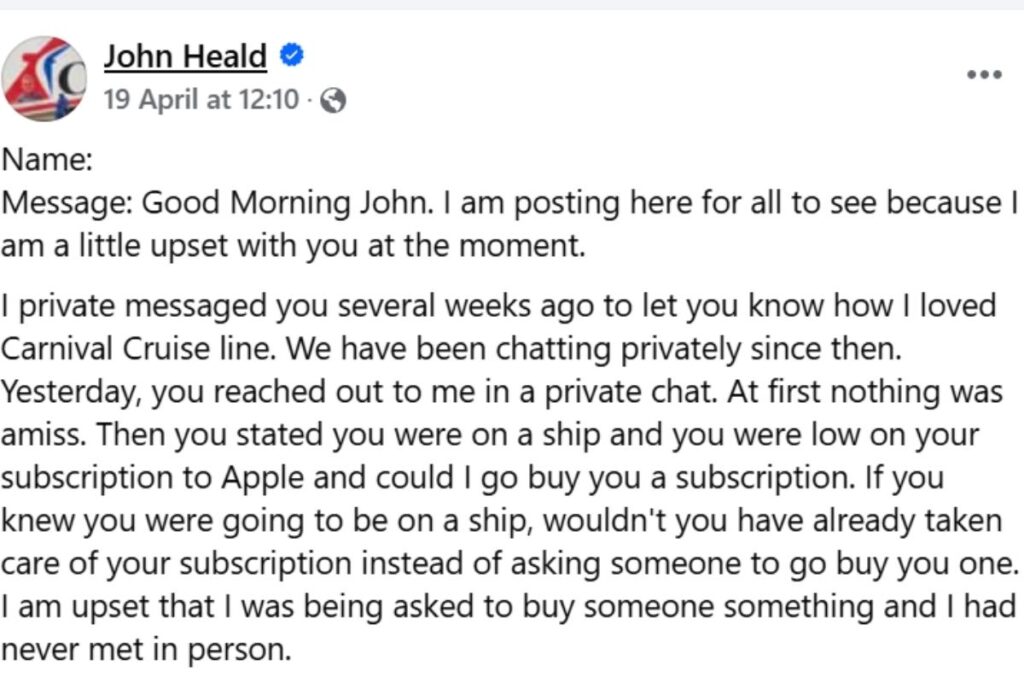
Actual crew members aren’t privately messaging passengers to ask for cash. If an account tries it, report it, block it, and don’t keep chatting out of politeness. I’d also be careful about oversharing in public cruise groups, because scammers love piecing together little details that make them sound believable.
5. Discount Excursion Scams

This is one of the easiest traps to fall into in port because it plays on a very real thought: why pay cruise line prices when a local guide is offering the same thing for half the cost?
Sometimes those independent tours are perfectly fine. Sometimes they’re a mess.
You might end up on a rushed, low-quality excursion, get taken somewhere completely different from what was promised, or worse, get back late and watch your ship sail away without you. That’s not the kind of souvenir anyone wants.
If you’re booking outside the cruise line, stick with reputable third-party providers that have plenty of recent reviews. Make sure return times are crystal clear, and avoid handing cash to someone who approaches you on the street five minutes after you step off the ship.
A cheap tour stops looking cheap the moment it leaves you stranded.
6. The “Free Resort Day Pass” and Travel Club Pitch

This one sounds amazing at first.
Someone in port offers you a free resort pass with transportation, drinks, and food included. The only catch? You have to sit through a short presentation first.
That “short presentation” can turn into a full-pressure sales pitch for a travel club or vacation membership with a chunky upfront fee and ongoing costs that somehow keep getting brushed past.
By the end, people feel cornered, worn down, and sometimes a little too relaxed after the free cocktails to think clearly.
If someone offers you a free resort day, assume there’s a catch somewhere. If you’re still tempted, look up the company yourself before agreeing to anything, and don’t sign a contract on the spot. Ever.
7. Taxi Scams in Cruise Ports

Taxis can be a lifesaver in port. They can also be an easy way to get overcharged if you’re not careful.
Some of the oldest tricks still work because cruise passengers are in a hurry and usually unfamiliar with local fares. A driver quotes one price, then later claims it was per person. Another says they have no change. Some push “better” beaches, shops, and restaurants because they get a kickback for bringing you there. Others aren’t licensed at all.
I’ve found the safest move is to agree on the total fare before getting in, carry small bills, and stick with official taxi lines or ride apps where they’re available.
And if a driver starts steering you away from the place you actually want to visit because they “know somewhere better,” that’s usually your cue to smile and say no thanks.
8. The “Free Gift,” “Please Hold This,” and “Bump And Break” Scams

Port scammers love confusion.
Sometimes it starts with a “free” bracelet, flower, or trinket. The moment you touch it, the sales pressure begins. Other times, someone asks you to hold an item for a second, then another person appears accusing you of stealing or damaging it. And then there’s the classic bump-and-break trick, where someone crashes into you, drops a phone or glasses, and demands money because you “broke” it.
All three scams work the same way: they put you on the spot and hope you’ll pay just to make the drama go away.
The best response is simple. Don’t take the gift. Don’t hold items for strangers. And if someone starts accusing you of breaking something in a crowded area, offer to involve port security or the local police. That usually shuts the whole thing down pretty quickly.
9. Pickpockets and Phone Theft

Cruise ports are packed with distracted tourists, which makes them prime territory for pickpockets.
A spill on your shirt. A map shoved in your face. A crowd closing in around you. These distractions aren’t always random. Sometimes they’re the setup.
I once watched a passenger get flustered after someone “accidentally” made a mess on him while another person hovered nearby trying to help clean it up. That kind of chaos is exactly when wallets and phones disappear.
And don’t hand your unlocked phone to just anyone for a photo, either. Most people are harmless, but all it takes is one thief standing in the right spot at the right time.
Keep valuables zipped up, carry only the cash you need, and stay a little more alert in crowded tourist areas than you normally would. It sounds boring, but boring beats replacing your phone in a foreign port.
10. Fake Onboard Events and Cruise Group Meetups
Not every scam happens at the port or in your inbox. Some start weeks before sailing in cruise Facebook groups and roll call chats.
A post goes up about a paid meetup, a cabin crawl, a private tasting, or some other “special” onboard event that supposedly needs a fee in advance. It sounds fun, low-stakes, and just believable enough that people send the money without thinking too hard about it.
Then the cruise begins and the event is nowhere to be found.
Plenty of unofficial group meetups are harmless, but the moment someone asks for cash up front, I’d want proof the event is real. If it’s a paid activity, it should be backed by something official — the cruise line’s app, the daily schedule, or confirmation from the ship once you’re onboard. If none of that exists, I’d skip it.
11. Art Auctions and Spa Upsells

Not every overpriced cruise purchase is technically a scam, but some come awfully close to feeling like one.
Art auctions can be fun, especially when there’s free bubbly involved, but the sales pitch can make mass-produced pieces sound like rare treasures. If you’re not already confident buying art, treat the whole thing as entertainment, not an investment strategy.
The spa can be similar. You book a relaxing treatment and somehow leave with a small mountain of skincare products and a much bigger bill than expected. In some cases, people don’t realize how much has been added until they check the receipt.
The fix for both is the same: slow the moment down. Don’t buy under pressure, don’t sign anything until you’ve checked the total, and don’t let a polished sales pitch empty your onboard account.
Bottom Line
Cruising should feel fun, not like a part-time job in fraud prevention.
But a little caution goes a long way. Check who you’re paying. Be wary of random messages, surprise fees, and anyone offering something for free in port. And when something feels rushed, weird, or just a little too convenient, trust that instinct.
Scammers love distracted travelers. They love people who feel pressured to decide fast. The good news is that once you know their playbook, they get a lot easier to spot.
So go enjoy the ship, enjoy the ports, and keep your eyes open. That way, the only stories you bring home are the ones you actually want to tell.
Today’s Top Cruise Deals
See today’s best deals from ALL travel agents






I might try a fluvial cruise. Any recommendations about that type of cruises?