Maritime technology company MXP365 has launched a new Babyphone mobile app for cruise passengers traveling with young children.
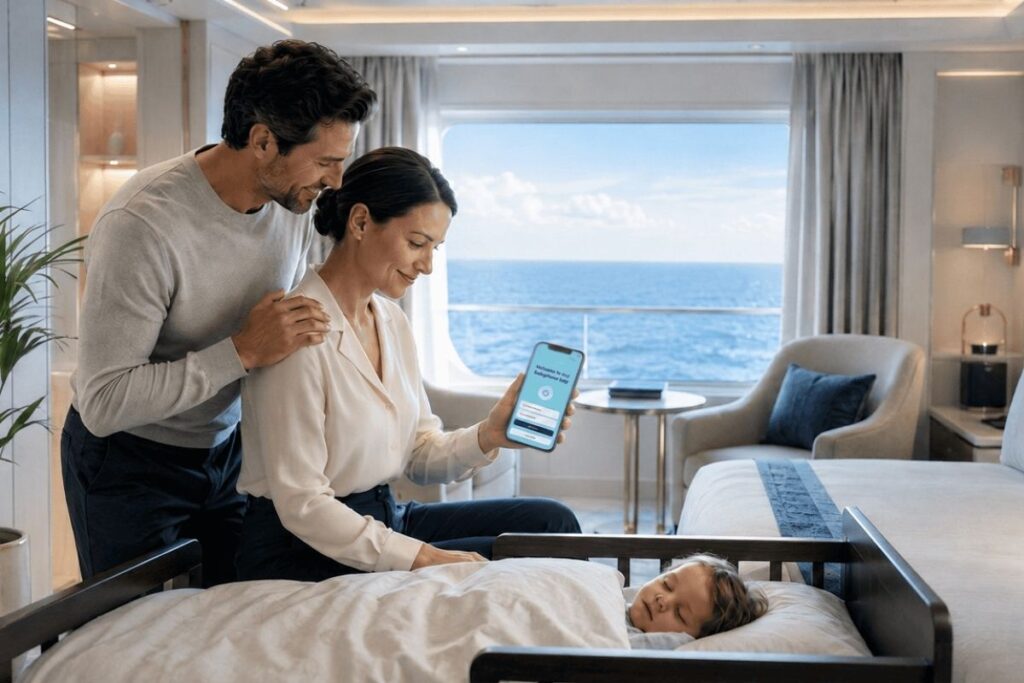
The app is intended to help parents move around the ship more freely by giving them access to live cabin video and alerts through the vessel’s onboard Wi-Fi, rather than a conventional internet connection.
New App Aims to Give Parents More Flexibility On Board
The idea behind the Babyphone app is to address a familiar problem for parents on cruises. When a child is asleep in the cabin, options can be limited if adults want to head to dinner, watch a performance, or spend time elsewhere on board.
The app is meant to make that balancing act easier by letting parents check in remotely instead of automatically arranging babysitting or giving up evening plans.
Haile Costner, project manager at MXP, highlighted the main benefit of the app, saying, “With the MXP365 Babyphone mobile app, parents have more flexibility onboard. With secure live monitoring and notifications, families can stay connected with their children.”
Designed to Work Over the Ship’s Own Wi-Fi
A notable part of the system is that it operates over the ship’s own Wi-Fi network. In practical terms, that means it can work without depending on an external internet connection.
That setup matters on a cruise, where internet service can be costly, uneven, or restricted by bandwidth. By keeping the connection onboard, the app avoids some of the usual frustrations tied to satellite service and mobile data charges.
MXP365 said the app links devices through a secure local connection on the vessel, allowing parents to monitor their cabin from other areas of the ship.
Because it relies on the ship’s existing network, the service is expected to function whether the vessel is at sea, close to shore, or sitting in port.
Live Video and Automatic Alerts
Its main features are a live video feed and an alert system designed to notify parents when attention may be needed.
Parents can open a live view from the cabin and check on their child while elsewhere on board.
The notification feature can be set to respond to things such as crying, movement, or other selected triggers. The aim is to help parents react quickly without needing to stay close to the room the entire time.
Together, those tools are meant to give families more reassurance. Instead of choosing one or the other, parents may be able to enjoy onboard activities while still keeping watch.
Another Example of Family-Focused Cruise Tech
The launch of the Babyphone app also reflects a larger push across the cruise industry toward family-focused amenities and onboard technology.
Families with young children have become an increasingly important market for cruise lines over the past decade. In response, many operators have invested in kids’ clubs, family entertainment, and stateroom options built for multi-generational travel.
Even so, one common problem has remained: how parents can monitor children who are sleeping or resting in the cabin while still enjoying the ship in the evening.
On many cruise ships, babysitting services are available, but they can be costly and may need to be booked in advance. The Babyphone app offers a more flexible alternative, allowing parents to make last-minute decisions without added cost or scheduling issues.
MXP365 Expands Its Maritime Technology Offering
MXP365 is already known for providing digital tools for the maritime and cruise sectors. The company focuses on communication and connectivity systems built for the specific demands of shipboard use.
The Babyphone app marks a move into passenger-facing technology. While MXP365 has mainly been associated with operational tools and crew connectivity, this launch suggests a broader focus on improving the guest experience as well.
That could be a significant step for the company. As cruise passengers increasingly expect the same digital convenience on board that they have on land, firms like MXP365 may play a bigger role in closing that gap.
Security and Privacy Questions Remain
As with any video monitoring system, especially one involving children, privacy and security are likely to be major concerns for parents.
MXP365 has described the Babyphone app as secure, but the initial announcement did not include detailed information about encryption standards or how data is handled.
Families may want more clarity on whether video feeds could be accessed by anyone else, intentionally or otherwise. The fact that the app works through a closed shipboard Wi-Fi network may offer some built-in protection, since the connection does not pass over the public internet.
Still, cruise lines using this type of technology may need to provide clear answers on several points, including whether footage is stored, who can access it, and how long any data is kept.
What the Launch Could Mean for Cruise Lines
The arrival of the Babyphone app could point to wider adoption of similar technology across the cruise market.
If one provider successfully introduces this type of family-focused tool, others may feel pressure to respond. Cruise lines could partner with MXP365, add similar functionality to their own apps, or develop competing systems in-house.
That could make onboard technology a bigger part of how family cruises are marketed and compared. In the future, digital features may influence booking decisions alongside more traditional factors such as cabin design, dining options, and children’s programming.
Looking ahead, this kind of baby monitoring technology could develop further. Future versions might include two-way audio, temperature and humidity monitoring, or links to onboard services for extra support.
For now, the Babyphone app gives a clear sign of where family cruise technology may be heading next.
Today’s Top Cruise Deals
See today’s best deals from ALL travel agents