Ever sat at dinner on a cruise and wondered how much your waiter earns, especially knowing many crew come from countries like the Philippines or India? Or spotted the ever-smiling cruise director and thought, there’s no way he’s faking that grin… right? Must be on a decent wage!
If you’ve ever been curious about what life is like working on a cruise ship, financially speaking, you’re not alone. Whether you’re dreaming of running away to sea or just nosy (no judgement), we’re breaking down what crew members actually earn on major lines like Carnival, Royal Caribbean, and Disney.

Let’s unpack the paychecks and perks of cruise ship staff from the high seas with Carnival, Disney, and Royal Caribbean. And who knows? By the end of this article, you might even consider a career on a cruise ship.
What’s in the Wallet of Cruise Ship Crews?
Let’s talk numbers. On average, cruise ship workers earn less than the typical American, but quite a bit more than workers in many other parts of the world. That’s part of the reason why so many crew members come from countries where cruise ship wages can offer a significant boost to their families back home.
Here’s what the big three cruise giants were paying as median annual salaries the last time they shared data (as recently as 2024, but take this with a pinch of sea salt):
- Carnival Group dished out about $16,854
- Norwegian Cruise Line Holdings was a bit more generous with $23,312
- Royal Caribbean Group wasn’t far behind at $18,799
All figures are in US dollars, and yes, it’s been a few years. Cruise lines don’t exactly rush to update these publicly. No major pay hikes have been reported, so these numbers still give a rough idea.
To put that in context, here’s how those figures stack up against median annual salaries in various countries using 2024 data:
- USA: $63,360
- Australia: $48,500
- UK: $47,100
- Lithuania: $27,276
- Spain: $25,324
- Chile: $9,792
So while the pay might not be impressive compared to Western wages, it can be life-changing depending on where you’re from, especially when your food, accommodation, and travel are covered.
The Bigger Picture: Salary vs. Lifestyle
Yes, cruise ship workers might earn less than the average American, but for many crew members from countries in Asia, South America, and Eastern Europe, the pay can be a game-changer.
One American crew member even shared how colleagues proudly showed him photos of the homes they’d built back home: think three-bedroom houses with ocean views and private pools, all funded by cruise ship earnings.
But there’s a catch. These salaries don’t tell the full story, especially when you factor in the hours. Some crew work up to 14 hours a day, seven days a week. Others, like performers or guest entertainers, may only work a few hours per day. It all depends on the role.
Contracts usually run from two to eleven months, with most falling between four and eight. After that, crew members typically get a couple of months off to rest and hopefully spend some of those hard-earned wages.

Perks on Board: More Than Just a Salary
Life at sea comes with its own set of perks. We’re talking about basics like food, accommodation, laundry, and nice-to-haves like training, medical care, and even flights to and from the ship.
And let’s not forget the discounts for family cruises. However, if you want to Instagram your adventures, you’ll have to pay for the WiFi or hunt down hotspots on port days.
Who Makes What
Ever wonder who’s bagging the most? From the captain’s deck to the service floors, here’s a sneak peek:
Captains
Fancy being the one steering the ship? Cruise ship captains earn an average of up to $130,000 per year, but that can vary massively depending on the size of the ship and their experience.
A newly promoted captain on a small vessel might earn around $75,000, while those in charge of mega-ships with 20+ years at sea can make up to $200,000. Not bad for a life spent navigating the high seas.
On top of their salary, captains often receive up to $40,000 in bonuses and $3,000 in profit sharing. They typically work three months on, three months off, though they’re on call 24/7 while onboard, so it’s not all cocktail parties and photo ops with guests.
Related reading: Revealing What Cruise Ship Captains Really Earn

Cruise Directors
They’re the life of the party, the voice over the loudspeakers, and the ones making you laugh at the theatre shows — but cruise directors do a lot more than just tell jokes and introduce acts.
On average, cruise directors earn around $60,000 a year. Newbies usually start closer to $45,000, while the most experienced (and charismatic) cruise directors can pull in six figures — over $100,000 annually.
Behind the scenes, they run the entire entertainment department. That means managing hundreds of staff: from performers and musicians to lighting techs and kids’ club workers. It’s a big job — and a long day. Expect 11 to 14 hours on sea days, and 6 to 8 hours on port days. Contracts typically run six months on, followed by a well-earned six-week break back home.
Related reading: Your Carnival Cruise Director Guide for 2025/2026
Waiter Salaries
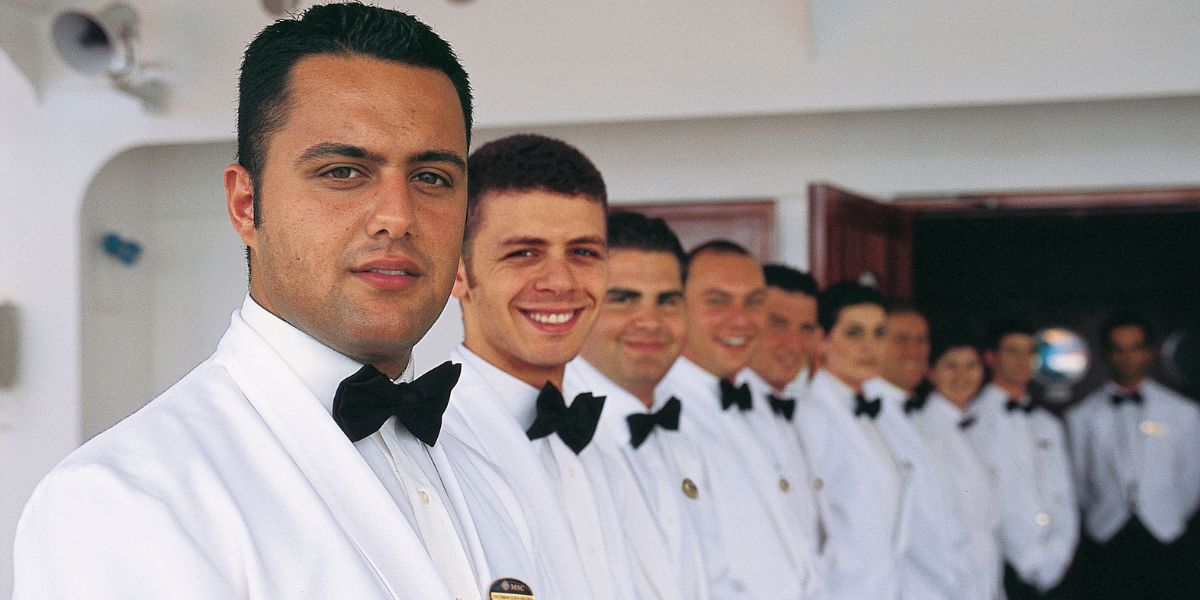
Waiters on cruise ships work hard. We’re talking breakfast, lunch, and dinner service — often with only short breaks in between. It’s a demanding role, but it can pay off, especially on higher-end lines.
Salaries vary widely: junior waiters typically earn around $1,200 per month, while head waiters on luxury ships can take home up to $5,000 monthly. These figures usually include automatic gratuities, which are pooled and distributed among the team.
And if guests feel extra generous? Cash tips on top of the usual gratuities go straight to the waiter, a welcome bonus for those pulling 12+ hour shifts with a smile.

Cruise Ship Chef Salaries
Feeding thousands of guests a day is no small feat, and cruise ship chefs are the ones making it all happen, from the midnight buffet to the fancy gala dinners.
At the top of the kitchen hierarchy, executive chefs can earn up to $6,500 per month, depending on the cruise line and ship size. A Chef de Partie (in charge of a specific section like pastry or grill) will usually make between $3,200 and $4,600 per month, while trainee cooks start at around $800, climbing the ranks as they gain experience.
Most cruise chefs have solid backgrounds in luxury hotels or large-scale restaurants, and they need it. Hours are long (think 10+ hours a day, seven days a week), and the pressure is high. But if you love the heat, this kitchen can be a rewarding place to be.
Bartender Salaries

Cruise ship bartenders don’t just mix mojitos and pour piña coladas, they often do it for 12 hours a day, with barely a day off during their contract.
Pay typically ranges from $1,400 to $2,600 per month, depending on the cruise line. That includes automatic gratuities, but like waiters, bartenders can earn extra cash tips if guests are feeling generous (or just really liked that espresso martini).
It’s a high-energy, guest-facing role, and while it might look like fun from the other side of the bar, it takes stamina, speed, and a great memory for drink orders and names.
Cruise Ship Doctors
Being a doctor at sea isn’t just about handing out seasickness tablets. It’s a serious role with serious pay to match.
Cruise ship physicians earn around $7,500 per month, while chief doctors can bring in up to $12,000 monthly, depending on the cruise line and their experience level.
Most ships sail with one doctor and two nurses, but on the larger floating cities, you might find two doctors supported by a small medical team. They’re on hand for everything from minor injuries to major emergencies.
Related reading: Do Cruise Ships Have Doctors? What Really Happens If You Get Sick at Sea

Cruise Ship Nurses
While guests are sipping cocktails and lounging poolside, cruise ship nurses are quietly holding the fort, ready for anything from a stubbed toe to a full-blown emergency.
Salaries start around $4,200 per month for standard nursing roles, rising to $4,800 for a chief nurse. Nurse practitioners, who have more advanced training, can earn between $5,200 and $6,100 per month.
Most ships carry up to four nurses, along with one or two doctors and sometimes a couple of paramedics, especially on larger vessels. It’s a tight-knit team with a big job, because when something goes wrong at sea, they’re your first (and only) responders.
Cruise Ship Performers
Whether it’s live music in the atrium or a Broadway-style production in the theatre, cruise ship entertainment is a big deal, and for performers, it can be a pretty rewarding gig.
Musicians typically earn between $1,400 and $3,500 per month, with Caribbean band members on the lower end and popular piano bar entertainers pulling in the top rates.
Dancers in production shows usually earn $2,400 to $3,800 per month, depending on experience and the cruise line. It’s physically demanding work, think nightly shows, rehearsals, and themed events.
Then there are the guest entertainers, comedians, magicians, ventriloquists, acrobats, who swoop in for short contracts and command fees of $6,000 per month or more. The more crowd-pleasing the act, the better the paycheck.
Related reading: How This Cruise Ship Dancer Went From $300 a Week to $19,000 a Month

Spa & Salon Salaries
For those working behind the scenes with their massage oils and nail kits, it can be a solid way to earn at sea.
In addition to their base pay, spa and salon staff often earn commission on product sales and tips from happy guests, which can seriously boost their income.
Here’s what some of the most common roles typically earn per month:
- Beauty therapists/aestheticians: $2,400–$4,200
- Nail technicians: $2,400–$4,200
- Hairdressers/barbers: $2,200–$4,400
- Massage therapists: $2,800–$4,500
It’s not an easy ride, hours are long, and the pressure to sell can be high, but for many, it’s a chance to travel the world doing what they love, all while making guests feel their best.

Who Earns the Most at Sea?
You might think the captain always takes home the biggest paycheck, but that’s not always the case. In fact, chief engineers, ship doctors, and celebrity guest entertainers sometimes earn more, especially those brought on for short, high-impact contracts.
One thing that might surprise you? Pay doesn’t always match hours worked. Some of the hardest-working crew members, like room stewards, waiters, and even captains, put in long, demanding days. Meanwhile, musicians, photographers, and guest entertainers can enjoy shorter hours with pretty decent pay.
So, while cruise life might seem glamorous from the outside, the reality is a mixed bag; some roles offer great money for minimal hours, while others involve serious graft for more modest rewards.
Do Cruise Ship Workers Get Days Off?
Short answer? Not really. Most cruise ship crew work seven days a week for the entire length of their contract, which can be anywhere from a couple of months to almost a year.
There aren’t traditional “days off” like you’d get in a land-based job. Instead, crew work on a tight rotation and grab rest when they can, often during quiet periods or in between shifts. Once a contract ends, though, most take a well-earned break on land (usually a month or two) before heading back to sea for their next stint.
It’s intense, but for those who love travel and don’t mind long hours, it can be a rewarding way to see the world and stack some savings.

Crew Quarters: Living Below Deck
Cruise ship workers don’t just work on board, they live there too. Crew quarters are usually located on the lower decks, just above the waterline and below the guest areas. It’s not luxury living, but it’s practical, with compact cabins, shared facilities, and easy access to crew-only spaces like the mess, laundry, and gym.
Officers and the Captain often get upgraded digs, with private cabins located closer to the bridge, a perk that comes with the stripes.
Related reading: Ever Tried to Find Deck 1? Here’s Why Most Cruise Ship Deck Plans Skip the Lowest Level
Do Cruise Ship Workers Pay Tax?
It depends on where you’re from. Most cruise ship employees pay income tax in their home country, even if they’re working in international waters.
If you’re from the UK, there’s a handy perk: the Seafarers’ Earnings Deduction. It allows eligible seafarers to claim 100% tax relief on their earnings, as long as they spend fewer than 183 continuous days on land. So yes, the taxman still watches the horizon, but there are ways to stay in calm financial waters.
Is a Cruise Ship Job Worth the Plunge?
So, how much do cruise ship workers really make? Well… it depends. Salaries vary hugely depending on the role, experience level, and cruise line, from entry-level waiters to senior officers and star entertainers.
But the headline number doesn’t tell the whole story. Living costs are low; accommodation, meals, and even laundry are usually covered, so what you earn can go much further than it would on land.
For those who stick with it and climb the ranks, working at sea can be more than just an adventure, it can be a genuinely well-paying career with world travel thrown in.
Today’s Top Cruise Deals
See today’s best deals from ALL travel agents
You Might Also Like to Read






Thanks for reading!
I'm Kat, and I've been cruising for as long as I can remember — now I get to carry on the tradition with my own family!
If you enjoy my cruise tips, be sure to follow me on social media for more...