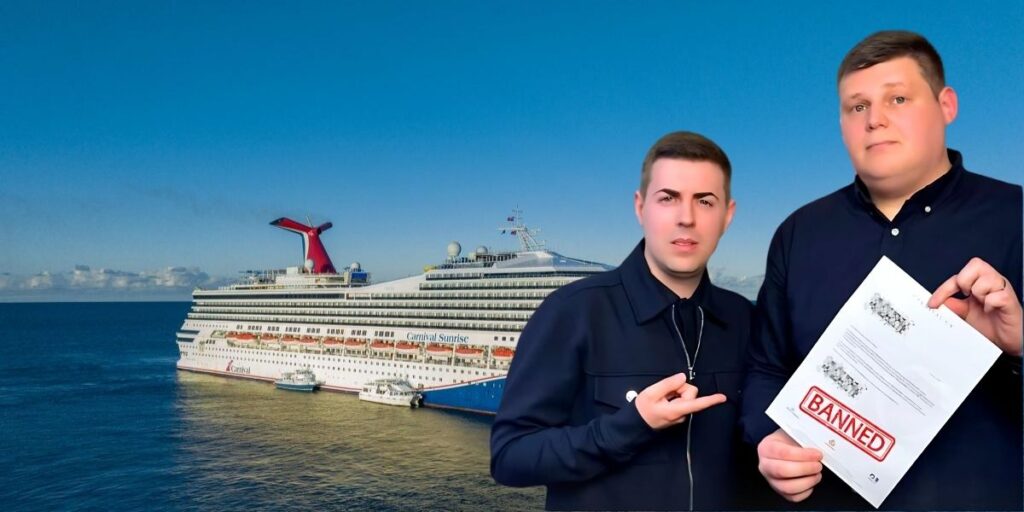
Two cruise reviewers have found themselves banned from every cruise line under the Carnival Corporation umbrella, a total of 93 ships across eight major brands, following a string of public critiques and candid reviews.
Dan Wailing and Jay Cannon, the duo behind Sail Away Magazine, say they were shocked to receive the letter from Carnival UK, informing them they would no longer be allowed to sail with any of the company’s cruise lines for at least the next five years.
The story has sparked debate across the cruising world. Is this a reasonable move by a company trying to protect its reputation, or does it raise concerns about free expression and criticism in the age of influencers and independent media? Let’s take a closer look at both sides.
Who Are Dan and Jay?
Dan Wailing and Jay Cannon are well-known figures in the cruise community, particularly in the UK. Together, they run Sail Away Magazine, a print publication dedicated to cruise news and reviews. In addition to the magazine, they host a popular podcast and a YouTube channel with over 40,000 subscribers.
Their mission is to provide honest, experience-based commentary on the cruise industry, whether good or bad. Over the past year, they’ve made a point of asking “difficult questions,” often highlighting guest complaints, service cutbacks, and changes within major cruise lines. While their content isn’t always critical, they’ve gained a reputation for being unapologetically candid, a style that has earned them both loyal followers and industry pushback.
What Did the Letter Say?
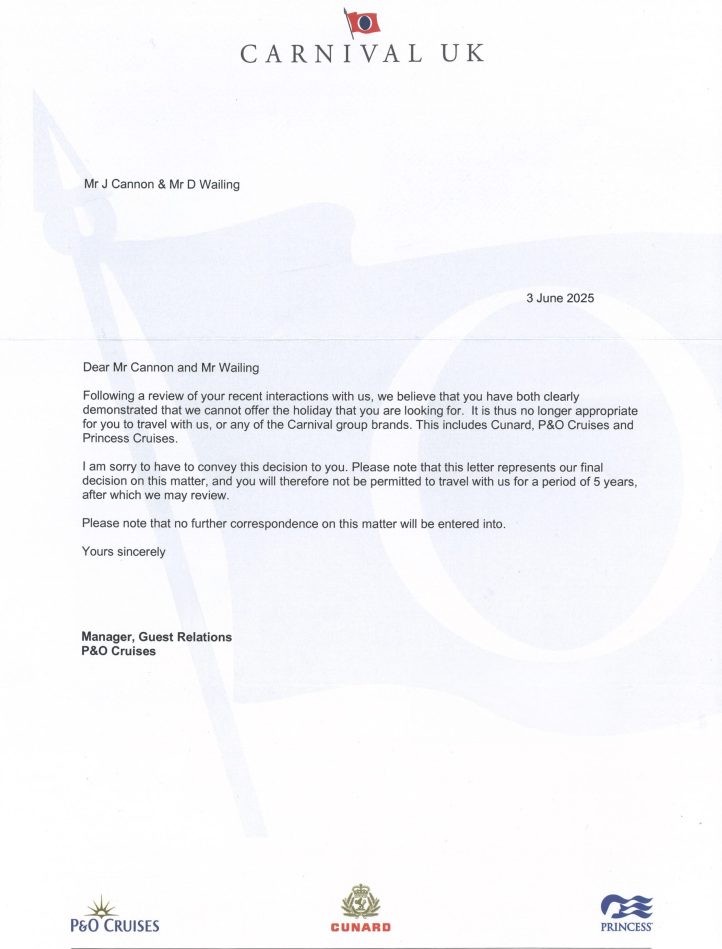
Dan and Jay revealed that they received a formal letter from Carnival UK, informing them that they were banned from sailing with any of the Carnival Corporation cruise lines for a period of five years. The letter stated:
“Following a review of your recent interactions with us, we believe that you have both clearly demonstrated that we cannot offer the holiday that you are looking for. It is thus no longer appropriate for you to travel with us, or any of the Carnival group brands. This includes Cunard, P&O Cruises and Princess Cruises.
I am sorry to have to convey this decision to you. Please note that this letter represents our final decision on this matter, and you will therefore not be permitted to travel with us for a period of 5 years, after which we may review.”
The ban applies to all eight brands under Carnival Corporation:
- Carnival Cruise Line
- Princess Cruises
- P&O Cruises
- Cunard
- Holland America Line
- Seabourn
- AIDA Cruises
- Costa Cruises
No specific examples of misconduct were cited in the letter, and Carnival UK has not issued a public statement on the matter.
Possible Reasons Behind the Ban
While the letter didn’t give explicit reasons, Dan and Jay believe it may be linked to several recent pieces of content that cast Carnival brands in a negative light. In a podcast episode discussing the ban, they questioned which of their critiques might have triggered the decision.
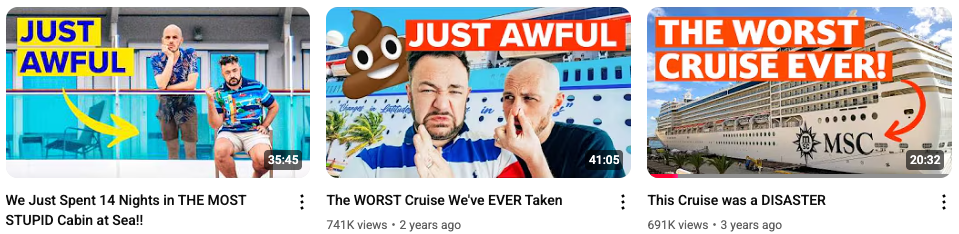
One likely candidate is their review of their first cruise with Carnival, which they described as the “worst cruise” they’d ever taken. They also criticised P&O Cruises after a sailing on Aurora was cancelled with less than 24 hours’ notice, a decision that left many passengers frustrated.
Other examples include a public poll they ran, which showed that 72% of their audience believed cruising had declined under the leadership of Carnival UK President Paul Ludlow. In another podcast episode, they recounted a call with Carnival UK’s PR and marketing team, during which they described the representatives as “delusional.”
While none of these incidents individually might seem to be a cause for a ban, the accumulation of critical commentary may have prompted Carnival UK to take action. Still, without specific details from the company, the exact rationale remains unclear.
Dan and Jay’s Response
Dan and Jay say they were taken aback by the decision and found the letter both vague and surprising. While they acknowledge that their content can be critical, they argue that it is always rooted in personal experience and intended to help improve the cruise industry, not tear it down.
They also expressed confusion over the scope of the ban, particularly the inclusion of cruise lines they’ve never even sailed with, such as Costa, AIDA, and Seabourn. From their perspective, grouping them with passengers who have been banned for disruptive or dangerous onboard behaviour feels unjustified.
What troubles them most is the potential precedent this sets, that honest, experience-based reviews, even if critical, could lead to exclusion from the very industry they report on.
A History of Critique and Praise
While Dan and Jay have certainly not held back when discussing shortcomings they’ve encountered, it’s important to note that their content hasn’t been universally negative. In fact, they’ve also praised cruise lines when they felt it was deserved.
A key example is their wedding cruise with Holland America Line, which they described very positively. The couple clarified that the cruise was offered by the company, they didn’t request it, and no content was expected in return, but they openly shared their appreciation for the experience.
They’ve also noted that they haven’t yet sailed with Costa Cruises, AIDA, or Seabourn, making it all the more surprising to them that the ban applies across the board. Their reviews of Princess Cruises and P&O Cruises date back over two years, and they say they’ve not had any recent sailings with those lines either.
This context raises a fair point, their content is a mix of criticism and celebration, not a blanket attack on cruising or Carnival brands.
Is This About Brand Protection or Censorship?
The ban has sparked wider debate within the cruise and travel community. Some see Carnival UK’s decision as a private company exercising its right to choose who it does business with. From that perspective, if Dan and Jay consistently found fault with their cruises, it might seem reasonable for the company to conclude that their brands simply aren’t the right fit.
Others, however, worry that this sets a concerning precedent, one where critical voices are silenced rather than engaged with. If reviewers fear losing access to future sailings for expressing honest, albeit negative, opinions, it could discourage transparency and weaken the value of independent feedback.
This isn’t the first time questions of censorship have arisen in the industry. A guest was previously banned from P&O Cruises after raising safety concerns on social media, and a resident on the Villa Vie Odyssey ship was reportedly banned for comments made in a private WhatsApp group, though that ban was later lifted.
So where is the line between constructive criticism and content a company deems damaging? And who gets to decide where that line falls?
Comparisons and Context
Dan and Jay are far from the only content creators sharing their cruise experiences online, both good and bad. One comparison they raised themselves is with fellow YouTubers who are also known for producing detailed cruise reviews that occasionally include criticism. Despite this, others have not faced similar repercussions.
This inconsistency has led some to question how decisions like this are made behind the scenes. Is it the tone of the content, the perceived influence of the creators, or something else entirely that prompts action?
The situation also highlights how travel media has changed. In an era where influencers, vloggers, and independent reviewers hold growing sway over public opinion, cruise lines, like other companies, are having to navigate how to respond to critique that reaches tens of thousands of people, sometimes instantly.
The Cruise Community Reacts
The news of the ban has sparked strong and often polarised opinions across social media. While some cruisers applauded Carnival for taking a stand, others defended the reviewers’ right to speak candidly about their experiences.
One commenter felt the decision was justified, suggesting that constant criticism, especially after being treated generously, could understandably push a company to act. Another argued that too many influencers focus on controversy to generate views, saying, “Bad news generates more likes than good news. Social media isn’t the best format to get the best information from.”
Others disagreed, pointing out that honest feedback, even if negative, should be welcomed by cruise lines looking to improve. One user noted, “They were honest about their experience. Carnival need to listen to criticism and act to improve or face the fact people will complain.”
Some took a more philosophical view, “There is free speech, and there is also free enterprise. People are jumping to conclusions without all the facts.”
Another highlighted the double standard, saying they regularly see glowing reviews for the same cruise lines, “So I reckon there are two sides to the story, and this is the carefully managed side.”
There were also practical takes, with a few simply shrugging off the ban, suggesting the pair should “cruise with a different line,” and naming Royal Caribbean, Celebrity, or Virgin as strong alternatives.
Overall, the reactions reflect just how complex this issue is. The debate touches not just on one couple’s ban, but on broader themes of trust, influence, free expression, and the evolving relationship between cruise lines and the people who review them.
What This Means for Travel Media
This situation raises bigger questions for the wider world of travel content. As more people turn to YouTube, podcasts, and social media for cruise advice and reviews, the line between guest experience and media commentary continues to blur.
For content creators, the concern is clear, if critical opinions, even those based on real experiences, result in bans, will others start self-censoring to avoid losing access? For cruise lines, it may be a question of protecting their brand from what they view as disproportionate or potentially damaging coverage.
Even as a cruise writer myself, this situation gives pause. Should I reconsider how I frame constructive criticism in my own articles? For instance, if I share negative feedback about my experience on a ship, could it impact my ability to sail with them in future?
Ultimately, this isn’t just about one couple or one cruise line. It’s about the evolving relationship between travel brands and the people who report on them, and how we strike a balance between open critique and mutual respect.
Final Thoughts
There are no easy answers here. On one hand, Carnival UK is fully within its rights to decide who it welcomes on board. If the company felt that Dan and Jay’s ongoing criticisms were incompatible with the experience they aim to provide, the decision could be viewed as a business choice, nothing more.
On the other hand, Sail Away Magazine’s supporters argue that fair and honest feedback is essential in any industry. Without independent voices willing to challenge cruise lines on service, communication, or guest satisfaction, travellers risk being left with only polished marketing messages.
Whether this ban was a justified response or a worrying signal for the future of travel media will depend on your perspective. But one thing is certain: as cruising continues to evolve, so too will the conversations around it, and those conversations matter.
Today’s Top Cruise Deals
See today’s best deals from ALL travel agents
You Might Also Like to Read
Thanks for reading!
I'm Kat, and I've been cruising for as long as I can remember — now I get to carry on the tradition with my own family!
If you enjoy my cruise tips, be sure to follow me on social media for more...